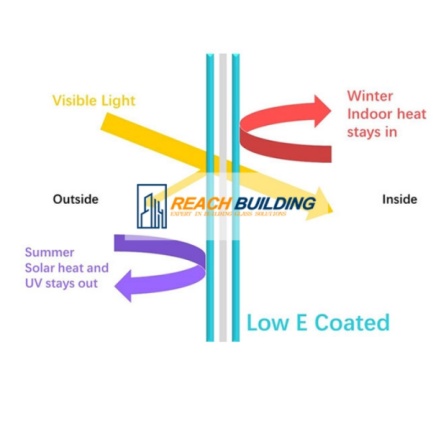
When people discuss modern energy-efficient glazing, low e glass is almost always part of the conversation. Yet many buyers, architects, contractors, and even project owners still hesitate when they encounter the two main categories: hard coat and soft coat. At first glance, both are designed to improve thermal performance by reflecting heat while still allowing visible light to pass through. In practice, however, they behave differently in terms of durability, processing, appearance, insulation performance, and application suitability. That is why understanding the distinction matters before making a specification decision.
What Is Low E Glass?
Low emissivity glass, usually called low e glass, is glass that has been treated with a microscopically thin coating designed to reduce the amount of infrared and ultraviolet energy passing through the glazing while still maintaining visible light transmission. In simple terms, it helps keep heat where it is wanted and reduces unwanted heat transfer.
This makes low e glass valuable in a wide range of building types, including:
· residential windows
· office facades
· curtain walls
· skylights
· doors and partitions
· energy-efficient renovation projects
Because energy codes and comfort expectations continue to rise, low e glass has become a standard solution rather than a niche upgrade. The real question today is usually not whether to use low e glass, but which type of coating is more suitable for the project.
The Two Main Categories of Low E Coatings
To understand the comparison properly, it helps to start with the manufacturing method. Hard coat and soft coat low e glass are not just marketing terms. They refer to two different coating technologies.
Hard coat low e glass is created using a pyrolytic process. During manufacturing, the coating is applied to the glass ribbon while the glass is still hot. Because of this, the coating becomes fused into the glass surface and forms a more durable finish.
Soft coat low e glass is produced using a sputter coating process after the base glass has already been made. The coating is deposited in a vacuum chamber in multiple ultra-thin layers, often including metallic compounds that improve thermal performance.
Even from this basic distinction, one major difference becomes clear: hard coat is generally tougher in exposed handling, while soft coat is typically more advanced in insulation performance.
Why the Coating Method Matters
The coating method directly affects how the glass behaves in processing, storage, and end use. This is where many specification decisions are won or lost.
Hard coat low e glass tends to be more robust because the coating is bonded into the surface during the hot manufacturing stage. That often makes it easier to handle in certain fabrication environments and more tolerant of exposure before it is incorporated into a finished glazing unit.
Soft coat low e glass, by contrast, offers excellent thermal performance because of its carefully engineered multi-layer coating system. However, the coating is more delicate and usually needs to be protected within an insulated glass unit. This means fabricators must pay closer attention to storage, handling, and assembly conditions.
For project teams, the coating method is not a technical detail to ignore. It shapes everything from logistics and processing choices to performance targets and final appearance.
Performance Comparison: Hard Coat vs Soft Coat Low E Glass
The most common reason people compare these two options is performance. Although both are low e products, they do not offer identical results.
Feature | Hard Coat Low E Glass | Soft Coat Low E Glass |
Coating process | Pyrolytic coating applied during hot glass production | Sputter coating applied in a vacuum chamber after production |
Surface durability | Higher exposed surface durability | More delicate, usually protected inside IG units |
Thermal insulation | Good | Generally better |
Solar control options | More limited | Usually broader and more precise |
Appearance | Slightly less neutral in some cases | Often more refined and visually consistent |
Processing flexibility | Can be easier in some applications | Requires stricter handling and fabrication control |
Typical use | Storm windows, monolithic uses, some IG units | High-performance insulating glass units, facades, premium windows |
This table does not mean soft coat is always better or hard coat is outdated. It means each type serves a different priority. If the project demands top-level thermal performance, soft coat often becomes the preferred solution. If durability and easier exposure tolerance are more important, hard coat may still be a strong option.
Hard Coat Low E Glass: Strengths and Limitations
Hard coat low e glass continues to be relevant because it offers a balanced combination of functionality and durability.
1.Key strengths
One of its main advantages is surface toughness. Since the coating is baked into the glass during production, hard coat products are generally more durable than soft coat coatings when exposed during fabrication or certain installation scenarios. This can simplify some handling requirements.
Another benefit is versatility in specific applications. Hard coat low e glass can be useful where a product may not always be sealed within a highly controlled insulated unit environment, or where the fabricator values coating resilience.
2.Main limitations
The limitation is that hard coat low e glass usually does not match the thermal efficiency of high-performance soft coat products. If the project is targeting very low U-values or stricter energy performance requirements, hard coat may not offer the same level of insulation.

Soft Coat Low E Glass: Why It Is Often Preferred in Modern Projects
Soft coat low e glass has become increasingly popular in commercial and residential glazing because it offers stronger thermal insulation and more sophisticated performance tuning.
Better energy efficiency
Soft coat coatings are often engineered in multiple layers to reflect heat more effectively. This typically results in better insulation performance, making soft coat a common choice for high-performance insulated glass units.
Greater design flexibility
Another advantage is product range. Soft coat low e glass is often available in different configurations that help balance visible light, solar heat gain, reflectivity, and interior comfort. This makes it easier for designers to adapt glazing choices to different climates and façade strategies.
Cleaner modern appearance
In many premium building applications, soft coat glass is favored for its more neutral appearance and more controlled visual performance. This can matter in curtain walls, commercial facades, and upscale residential developments where aesthetics are carefully managed.
The trade-off
Its main drawback is sensitivity. The coating is more delicate, so it usually needs to be protected inside a sealed insulating unit. Fabricators need stricter process control, careful storage, and correct assembly procedures.
Cost vs Value: Looking Beyond the Initial Price
It is tempting to compare hard coat and soft coat low e glass only by purchase price, but that approach can be misleading. In many cases, soft coat glass may come with a higher product and processing requirement, yet provide stronger energy savings and better building comfort over time.
Hard coat may appear simpler and more economical in some projects, especially where the performance target is moderate. But if the building owner values reduced HVAC demand, improved occupant comfort, and higher long-term efficiency, soft coat may offer better overall value.
A better way to evaluate cost is to ask:
· What is the building’s energy target?
· Is appearance a major factor?
· Will the glass be used in IG units?
· How important is long-term thermal performance?
· Does the processor have experience with the selected coating?
These questions lead to better decisions than price alone.
Conclusion
Hard coat and soft coat low e glass both play important roles in modern glazing, but they are not interchangeable products. Hard coat offers a more durable pyrolytic surface and can still be effective in certain practical applications. Soft coat delivers stronger thermal performance, broader design flexibility, and is often the preferred choice for high-performance insulated glass systems. The best decision depends on how the building will perform, how the glass will be processed, and what the project expects in terms of comfort, energy savings, and appearance. From our perspective, the smartest specifications come from understanding the real differences rather than relying on simplified assumptions. If you are evaluating glazing options for a residential, commercial, or façade project, it is worth learning more from HANGZHOU REACH BUILDING CO.,LTD. and discussing which low e glass solution is better suited to your actual application. We believe a practical, project-based conversation usually leads to the most reliable result.
FAQ
1. What is the main difference between hard coat and soft coat low e glass?
The main difference is the coating technology. Hard coat uses a pyrolytic process during hot glass production, while soft coat uses a sputter coating process after the glass is made.
2. Which type of low e glass has better insulation performance?
In most cases, soft coat low e glass offers better thermal insulation and is more commonly used in high-performance insulating glass units.
3. Is hard coat low e glass more durable than soft coat?
Yes, the coating on hard coat low e glass is generally more durable when exposed because it is fused into the glass surface during production.
4. Can soft coat low e glass be used in standard building windows?
Yes. It is widely used in modern residential and commercial windows, especially when stronger energy efficiency and better visual performance are required.