| Availability: | |
|---|---|
| Quantity: | |
Low Iron Laminated Glass, a high-performance safety glass from Hangzhou Reach Building, is crafted by bonding low-iron glass layers with PVB or SentryGlas interlayers. It stands out with 88%-90% visible light transmission (no green tint), shatter-resistance, UV protection (blocks over 99% UV rays), and sound insulation (STC 32-38). Suitable for facades, skylights, railings, interior partitions, and flooring, it supports custom sizes (150×150mm to 12000×3600mm) and meets global certifications like CCC and ASTM C1048.
| THICKNESS DETAILS | 3+0.38pvb+3mm; 4+0.38pvb+3mm; 5+0.38pvb+5mm; 6+0.38pvb+6mm; 3+0.76pvb+4mm; 4+0.76pvb+4mm; 5+0.76pvb+5mm; 6+0.76pvb+6mm etc |
| Visible Light Transmission (VLT) | 88%-90% |
| Solar Heat Gain Coefficient (SHGC) | 0.60 - 0.80 |
| Sound Insulation (STC) | 32-38 |
| Thermal Strength | 300°C to 400°C |
| Thermal Conductivity (U-value) | 3.5 - 5.5 W/m²K |
| Maximum Size | 12000mm x 3600mm (Custom sizes available) |
| Minimum Size | 150mm x 150mm(Custom sizes available) |
| Delivery time | 7 days |
1. High Clarity and Transparency
Due to the low iron content, it offers superior optical clarity, making it ideal for applications where true color rendering and maximum light transmission are critical.
2. Enhanced Safety and Security
The lamination process makes the glass shatter-resistant, adding structural integrity and safety. If broken, the glass remains bonded to the interlayer, reducing injury risk.
3. UV Protection
The interlayer provides excellent UV filtration, protecting interior materials from fading or damage due to sunlight exposure.
4. Sound Insulation
Laminated glass has sound-dampening qualities, making it a good choice for noise-sensitive environments.
5. Certificates
Suitable for use as a safety glass as defined by consumer product safety association 16CFR 1201, ansiz 97.1 1984 and BS6262.
Conforms to CCC, AS/NZS2208-1996, EN12150-1, and ASTM C1048. All work done on glass (beveling, cutting, bending, etc) must be done before tempering.
Enhanced Aesthetics: The high clarity and low tint of low iron glass make it perfect for architectural facades where appearance is critical. It provides a nearly colorless view that doesn't distort colors or compromise on aesthetics.
Safety and Security: Laminated glass adds a layer of safety to building exteriors, as it doesn't shatter into sharp fragments.
Superior Clarity: Low iron glass allows maximum light to enter, ideal for skylights, where natural lighting is the goal. It minimizes the greenish tint seen with regular glass, allowing truer, brighter light.
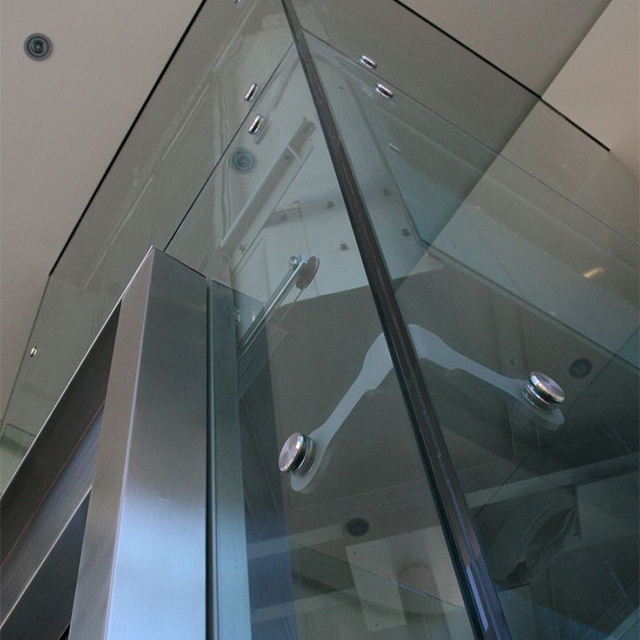
Modern Aesthetic Appeal: Low iron glass is ideal for railings in modern architectural designs. It offers a clearer view and adds a sense of openness to balconies, terraces, and staircases.
Sound Reduction: Especially in high-density areas, laminated glass railings can also act as a sound barrier, enhancing the comfort of the space.
Privacy and Acoustics: Low iron laminated glass is often used in interior partitions for offices, conference rooms, and retail spaces, where visual clarity, privacy, and noise control are important.
Transparency with Sound Insulation: The laminated structure offers sound-dampening benefits, which helps create a quieter, more focused environment without compromising transparency.
Decorative Applications: Low iron laminated glass can be easily customized with frosted or patterned interlayers, creating stylish and functional partitions in modern interiors.
Structural Integrity: Low iron laminated glass is sometimes used in glass flooring and stair treads. Its strength and resistance to shattering ensure safety in such applications.
Enhanced Visibility: Using low iron glass reduces the greenish tint, providing a clearer, more appealing aesthetic for glass floors or staircases, often seen in contemporary architectural designs.
Slip-Resistant Options: Many manufacturers offer laminated glass with slip-resistant interlayers or surface treatments, making it safer for foot traffic.
Surface Treatments
Edge Treatment: Flat edge, rounded edge, or beveled edge
There are three main types of edge treatments available. The flat edge provides a clean, straightforward appearance, which is often preferred in applications where a sharp, defined look is desired. The rounded edge, on the other hand, offers a softer, more comfortable feel, reducing the risk of injury from sharp corners. It's a popular choice for products that will be handled frequently. The beveled edge gives a more sophisticated and decorative touch, adding a sloped transition between surfaces.
Drilling: Available for mounting or installation purposes
Drilling services are provided to facilitate mounting or installation. Whether it's for affixing the item to a wall, a piece of furniture, or any other structure, the holes can be drilled to precise specifications, ensuring a secure and proper fit.
Sandblasting: Can be sandblasted for decorative finishes
Sandblasting is an option for achieving decorative finishes. This process involves propelling fine particles at high speeds onto the surface, creating a unique and textured look. It can be used to add visual interest, hide minor imperfections, or create a specific aesthetic appeal.
Brushed Finish: Available for a matte surface texture
For those who prefer a matte surface texture, a brushed finish is available. This finish gives the material a smooth, non - reflective appearance, which can enhance the overall elegance and understated charm of the product. It also helps to reduce fingerprints and smudges, making it more suitable for applications where cleanliness and appearance are important.
Coatings: UV protection, anti-reflective, or other coatings available upon request
A variety of coatings can be applied. UV protection coatings safeguard the material from the harmful effects of ultraviolet rays, which can cause fading, discoloration, and degradation over time. Anti - reflective coatings are beneficial in applications where glare needs to be minimized, such as in display screens or optical components. Additionally, other specialized coatings can be provided upon request to meet specific requirements, whether it's for corrosion resistance, scratch resistance, or any other functional or aesthetic need.
Packaging: used wooden boxes or cases, the cases should be easy loading, unloading and transportation. Each case needs to be packed with stuff of the same thickness and size.
Q: What are the advantages of ultra-white laminated glass over ordinary PVB laminated glass?
A:
Feature | Uitra-clear Laminated Glass | Ordinary PVB Laminated Glass |
Light Transmittance | High,up to 91%or more,crystal- clear with no green tint. | Lower,typically 85%-89%,with a slight green tint. |
Color Rendering | Excellent color fidelity,true-to-life visuals. | May distort colors due to inherent greenish tint |
Aesthetic Appeal | High-end,pure,and elegant appearance. | Standard look with a noticeable tint. |
Solar Energy Absorption | Lower,reducing heat buildup and thermal stress. | Higher,with more heat absorption and potential stress. |
Environmental | Made with low-iron materials,more | Higher iron content,less |
Impact | eco-friendly. | environmentally friendly. |
Applications | Ideal for premium settings like luxury buildings,museums. | Suitable for standard safety or functional applications. |
UV Protection | Blocks over 99%of UV rays,like ordinary PVB glass. | Also blocks over 99%of UV rays. |
Acoustic &Safety | Same performance as ordinary laminated glass. | Provides standard acoustic and safety performance. |
Durability | Maintains clarity and transparency over time. | May appear darker or aged due to inherent color. |
Price | Higher cost due to advanced production processes. | More affordable and widely used in standard projects. |
Q: How does Low Iron Laminated Glass compare to ordinary PVB Laminated Glass?
A: It has higher light transmission (88%-90% vs. 85%-89%), no green tint for better color fidelity, lower solar heat absorption, and a premium look—ideal for luxury projects. Both offer UV protection and safety, but ordinary glass is more affordable for standard use.
Q: What edge treatments are available for this glass?
A: Options include flat edge, rounded edge, and beveled edge. Additional customizations like drilling (for installation), sandblasting (decorative finishes), and anti-reflective/UV coatings are also offered.
Q: What’s the maximum size of Low Iron Laminated Glass?
A: The standard maximum size is 12000mm × 3600mm. Smaller custom sizes (minimum 150mm × 150mm) are available to fit specific project needs.