Introduction
The Glass Industry is entering a critical moment as 2026 approaches. Rising energy costs, stricter carbon rules, and supply chain pressure are reshaping how glass is produced and sold worldwide.
In this article, you will learn the three major trends shaping the Glass Industry in 2026: AI-driven manufacturing, circular recycling systems, and the shift toward low-carbon glass production.
Trend #1 – AI-Powered Digital Transformation in the Glass Industry
Digital transformation inside the Glass Industry has evolved. It is no longer about installing sensors. It is about turning data into operational decisions. In 2026, intelligence becomes embedded in manufacturing systems.
From Automation to Predictive Intelligence in Glass Manufacturing
Traditional glass plants rely on fixed automation systems. Operators monitor temperature, combustion ratios, forming speed, and annealing cycles. Adjustments are often reactive.
AI-driven platforms change this dynamic. They analyze live furnace data, combustion stability, melt chemistry, and forming behavior. Instead of responding after defects appear, systems predict deviations early and adjust parameters automatically.
Operational upgrades include:
● Real-time combustion optimization
● Dynamic batch composition balancing
● Melt viscosity prediction
● Forming-line speed stabilization
In large float and container facilities, reduced variability directly improves output consistency. Consistency reduces scrap. Scrap reduction improves margin protection.
AI-Enhanced Quality Control and Scrap Reduction
Quality control defines competitiveness in high-volume glass production. Minor defects in container glass raise rejection rates. Optical distortion in automotive glazing creates compliance risks. Thickness inconsistencies in float glass disrupt coating performance.
AI-powered inspection systems now scan surfaces at full production speed. They detect micro-bubbles, scratches, edge flaws, and distortion patterns. When anomalies appear, forming parameters adjust automatically.
Segment | AI Application | Operational Impact |
Container Glass | Surface inspection | Lower rejection rates |
Float Glass | Thickness control | Stable coating quality |
Automotive Glass | Optical analysis | Improved OEM reliability |
Reduced scrap does more than cut cost. It protects supply contracts and strengthens brand trust.
Predictive Maintenance and Energy Optimization
Glass furnaces operate continuously for years. Unplanned shutdowns disrupt contracts and damage credibility. Predictive maintenance systems analyze vibration signals, refractory wear patterns, and combustion stability.
Maintenance shifts from calendar-based scheduling to risk-based intervention. This reduces catastrophic downtime.
Energy optimization systems simultaneously monitor fuel efficiency relative to melt conditions. Since energy represents one of the largest cost components in glass production, continuous optimization creates measurable financial benefit.
Operational stability becomes a commercial advantage, not just a technical metric.
AI in Demand Forecasting and Supply Chain Strategy
Volatility remains present across construction, beverage packaging, and automotive sectors. AI forecasting models combine historical data with macroeconomic indicators. They support earlier production adjustments and better inventory alignment.
Strategic improvements include:
● Reduced overproduction
● Optimized raw material procurement
● Improved working capital control
● Better energy hedging strategy
The Glass Industry is shifting from reactive purchasing toward risk-managed procurement.
Digital Twins and Smart Factory Architecture
Digital twin technology simulates furnace behavior and batch chemistry before physical adjustments are made. Engineers test process changes virtually. It reduces experimental waste and accelerates R&D cycles.
Smart factory architecture integrates:
● IoT sensor networks
● Centralized dashboards
● Energy monitoring systems
● Production analytics platforms
Producers that integrate these systems respond faster to regulation and customer demands. They also build stronger internal decision frameworks.
Market Outlook: AI as Operational Standard in 2026
By 2026, AI-driven optimization is becoming baseline infrastructure among major producers in developed markets. It is no longer optional innovation. It is operational expectation.
Strategic outcomes include:
● More predictable cost structures
● Enhanced ESG reporting capability
● Improved customer transparency
● Greater resilience during volatility
The Glass Industry that invests in data protects both profitability and long-term competitiveness.
Trend #2 – Circular Economy Acceleration in the Glass Industry
Glass is infinitely recyclable without loss of quality. However, recycling performance depends on collection efficiency and industrial coordination. In 2026, circularity becomes central to strategy.
Bridging the Gap Between Recyclability and Recovery
While glass can be recycled indefinitely, effective recovery depends on sorting systems, contamination control, and regional infrastructure. Fragmented collection reduces cullet availability.
Improving recycling performance requires:
● Investment in sorting technology
● Municipal collaboration
● Deposit return systems
● Industrial-scale cleaning capacity
Circularity is not only environmental positioning. It is supply chain management.
Cullet as a Strategic Resource
Higher cullet ratios reduce melting energy demand. Recycled glass melts at lower temperatures than virgin raw materials. Increased cullet usage lowers fuel consumption and reduces carbon intensity.
Strategic benefits include:
● Energy cost reduction
● Lower raw material dependency
● Improved carbon reporting metrics
● Stronger brand positioning
Producers that secure long-term cullet supply reduce exposure to virgin material price swings.
Lightweighting and Circular Design Strategy
Lightweight container design reduces transportation emissions and logistics costs. It also aligns with sustainability-driven brand messaging.
In some regions, refill and reuse systems are expanding. Glass packaging becomes part of closed-loop distribution models. Circularity influences product design and operational planning.
Regulatory Expansion and Producer Responsibility
Extended Producer Responsibility frameworks are expanding. Producers face increased accountability for post-consumer waste management.
Companies that proactively integrate compliance into strategy convert regulatory pressure into differentiation.
Approach | Strategic Result |
Minimal compliance | Cost pressure |
Transparent reporting | Procurement advantage |
Integrated recycling partnerships | Cost stability |
Market Outlook: Recycled Content as Baseline Expectation
By 2026, high recycled content becomes standard expectation in packaging segments. Construction and automotive sectors increasingly request lifecycle transparency.
Producers without recycling integration risk competitive exclusion in premium markets.
Trend #3 – Decarbonization Becomes Commercial Strategy
Decarbonization is no longer a regulatory afterthought. It is now a procurement factor and valuation driver inside the Glass Industry.
Carbon Intensity and Regulatory Exposure
Glass furnaces operate at extreme temperatures and generate significant emissions. Carbon pricing systems and disclosure requirements increase financial exposure.
Ignoring carbon performance now creates strategic risk.
Hybrid and Electric Furnace Development
Hybrid furnaces combine electric boosting with combustion systems. They reduce emissions while maintaining operational stability.
Fully electric furnaces are emerging in targeted applications. Their viability depends on grid capacity and renewable electricity access.
Capital allocation decisions in 2026 influence emission intensity for decades.
Alternative Fuels and Low-Carbon Batch Innovation
Hydrogen blending and biofuel integration are progressing in multiple regions. At the same time, modified batch compositions aim to lower melting temperature requirements.
Technical complexity remains significant. However, incremental improvements compound over time.
Carbon Transparency as Sales Differentiator
Environmental Product Declarations and lifecycle assessments increasingly shape procurement decisions in construction and automotive sectors.
Transparent carbon reporting builds trust with developers, OEMs, and consumer brands. It strengthens negotiation power.
Market Outlook: Investment in Low-Carbon Glass Expands
Investment in furnace electrification, emission monitoring, and process optimization is expanding. Low-carbon glass production lines become strategic differentiators.
The Glass Industry transitions from carbon compliance to carbon competitiveness.
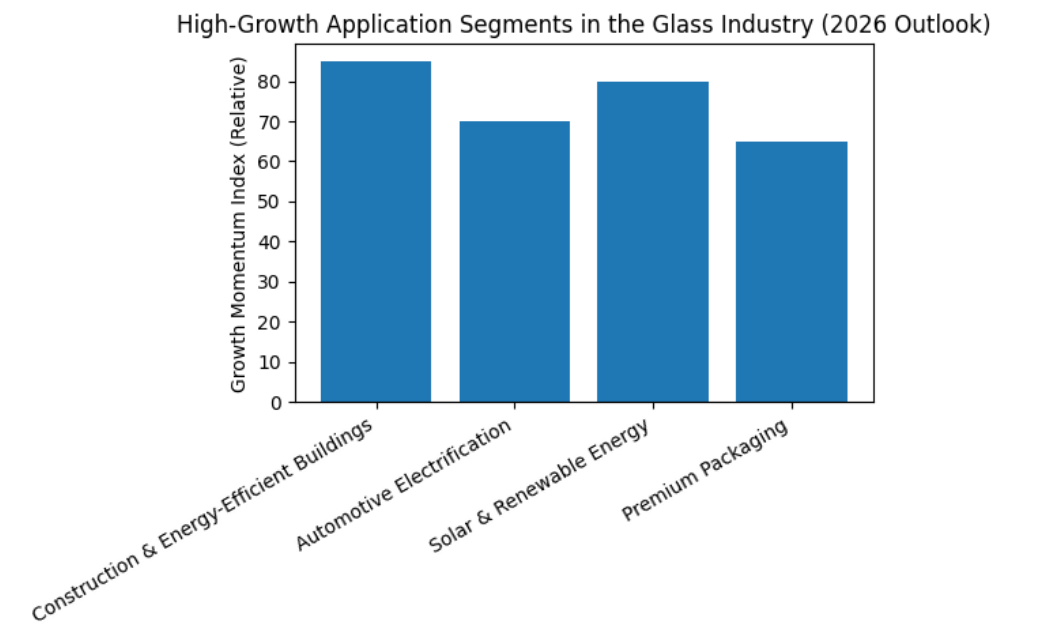
High-Growth Application Segments Driving the Glass Industry in 2026
Growth is not evenly distributed. Several segments demonstrate stronger structural momentum.
Construction and Energy-Efficient Buildings
Urban expansion and stricter building codes increase demand for:
● Low-E glass
● Solar control glazing
● Insulated glass units
● Smart switchable glass
Retrofit markets expand as older buildings upgrade façades for energy efficiency.
Automotive Electrification and Advanced Glazing
Electric vehicles require lightweight glazing to extend battery range. Panoramic roofs and acoustic laminated glass enhance comfort and design.
Automotive glass producers must deliver optical precision, structural reliability, and compatibility with integrated sensor systems.
Solar and Renewable Energy Infrastructure
Photovoltaic module production drives demand for durable, high-transmission glass. Solar installations expand across multiple regions, reinforcing flat glass growth.
Premium Packaging and Health-Focused Consumers
Consumers associate glass with purity and sustainability. Beverage, pharmaceutical, and cosmetic segments benefit from this perception.
Glass competes strongly against plastic in premium and environmentally conscious categories.

Regional Outlook: Where the Glass Industry Expands Fastest
Regional differences shape capital allocation decisions.
Region | Core Growth Driver | Strategic Priority |
Asia-Pacific | Urbanization and capacity expansion | Production scale |
North America | Retrofit and sustainability | Recycling and AI integration |
Europe | Carbon regulation | Electrification investment |
Middle East | Infrastructure megaprojects | High-performance flat glass |
Asia-Pacific continues large-scale infrastructure growth. Europe leads decarbonization policy enforcement. North America emphasizes retrofit markets. The Middle East invests heavily in façade-intensive architecture.
Key Risks and Strategic Challenges in 2026
Despite strong momentum across construction, renewable energy, and premium packaging segments, the Glass Industry still faces structural risks that could reshape margins and competitiveness in 2026. Growth does not eliminate exposure. In fact, rapid expansion often increases operational complexity and financial sensitivity.
Energy Price Volatility
Energy remains one of the largest cost drivers in glass manufacturing. Furnace operations require continuous high-temperature melting, which makes producers highly sensitive to fluctuations in natural gas and electricity prices. Sudden spikes directly compress margins, especially for companies operating under fixed-price contracts.
To reduce exposure, many glass manufacturers are expanding energy hedging strategies, exploring hybrid furnace systems, and investing in efficiency monitoring tools. Energy resilience is becoming part of long-term capital planning rather than short-term cost control.
Raw Material Constraints
Soda ash, high-quality silica sand, and other batch materials are critical inputs in the Glass Industry. Regional supply limitations, export restrictions, and logistics bottlenecks can disrupt production continuity. Even minor delays affect large-scale float and container plants that operate continuously.
Strategic responses include multi-source supplier networks, vertical integration where possible, and closer collaboration with raw material partners. Stability in batch material sourcing increasingly defines production reliability.
Regulatory Complexity
Environmental regulations, carbon disclosure rules, and cross-border compliance requirements continue to expand. Different regions apply varying emission standards, reporting frameworks, and recycling mandates. Managing these layers increases administrative workload and compliance costs.
Producers that centralize ESG reporting systems and integrate carbon data into operational dashboards reduce regulatory friction. Compliance is no longer just legal protection; it influences procurement eligibility in construction and automotive markets.
Material Substitution Pressure
Alternative materials such as advanced polymers, composites, and lightweight metals continue to compete in packaging, construction, and mobility sectors. While glass maintains strong sustainability advantages, price-sensitive markets may experiment with substitutes.
The competitive defense lies in innovation. Lightweight glass, high-performance coatings, smart glazing, and premium packaging design strengthen differentiation. Continuous R&D ensures that glass remains relevant in evolving application landscapes.
Mitigation across all risk areas requires diversification, long-term supply contracts, digital monitoring systems, and sustained innovation investment. Risk management is now a strategic discipline inside the Glass Industry, not a reactive measure.
Strategic Roadmap for Glass Industry Leaders
In 2026, leaders in the Glass Industry are defined less by scale alone and more by structural readiness. Competitive separation increasingly depends on strategic integration rather than isolated improvements.
High-performing companies typically demonstrate several shared characteristics:
● Early AI infrastructure deployment across furnace, quality, and supply chain systems
● Integrated recycling ecosystems with reliable cullet sourcing
● Transparent carbon reporting aligned with international standards
● Risk-managed procurement strategies covering energy and raw materials
● Clear value positioning beyond price competition
Operational intelligence and sustainability are no longer independent initiatives. They reinforce each other. AI improves efficiency. Circularity reduces cost exposure. Carbon transparency strengthens market trust.
The strategic shift from price-based competition toward risk-based partnership defines competitive advantage in 2026. Customers prefer suppliers who deliver reliability, regulatory readiness, and long-term stability. Companies that communicate this clearly position themselves as strategic partners rather than transactional vendors.
Conclusion
The Glass Industry is entering a new phase of transformation in 2026, where AI improves production stability, circular recycling lowers cost pressure, and decarbonization strengthens market credibility. Companies that integrate sustainability and data will lead future competition, while those delaying change may face increasing operational risks.
REACH BUILDING supports this transition by providing reliable glass solutions for modern construction projects. Their products offer durability, quality performance, and practical value, helping builders and developers achieve long-term efficiency and sustainable development goals.
FAQ
Q: What trends will shape the Glass Industry in 2026?
A: The Glass Industry will focus on AI manufacturing, circular recycling, and low-carbon production to improve efficiency and sustainability.
Q: Why is the Glass Industry investing in AI technology?
A: The Glass Industry uses AI to optimize furnaces, reduce defects, and improve production stability.
Q: How does circular economy affect the Glass Industry?
A: Circular systems increase recycled glass use, lower energy demand, and reduce raw material dependence in the Glass Industry.
Q: What role does decarbonization play in the Glass Industry?
A: The Glass Industry is adopting electric furnaces and alternative fuels to reduce emissions and meet new carbon regulations.
Q: Which sectors drive growth in the Glass Industry?
A: Construction, automotive electrification, solar energy, and premium packaging are major growth markets for the Glass Industry.