| Availability: | |
|---|---|
| Quantity: | |
Custom-formed glass solutions for interior, furniture, and decorative applications.
Heat Bending Glass is manufactured by heating flat glass until it becomes soft, bending it over a customized mold, and then cooling it naturally to achieve the desired shape. This process allows seamless creation of single-curved, double-curved, and complex 3D forms, making it widely used in furniture, interior decoration, and home appliances.
Unlike tempered curved glass, heat-bent glass remains annealed after forming. It offers excellent formability and aesthetic flexibility, but lower strength and safety performance — suitable for applications without strict safety or impact requirements.
| Characteristic | Heat Bending Glass | Tempered Curved Glass |
|---|---|---|
| Core Process | Heating → Mold Bending → Slow Cooling (annealing) | Heating → Mold Bending → Rapid Cooling (tempering) |
| Nature | Ordinary annealed glass | Safety glass |
| Strength | Same as normal glass, lower strength | 3–5× stronger, high impact resistance |
| Safety | Breaks into sharp pieces | Breaks into small safe particles |
| Thermal Stability | Weak, sensitive to heat stress | Excellent, withstands high temperature differences |
| Spontaneous Breakage | No | Very low probability (~0.3%) |
| Applications | Furniture, décor, appliances | Facades, skylights, balustrades, structural glazing |
| Cost | Lower | Higher |
Thickness: 4–19 mm
Glass Types: Clear, low-iron, tinted, patterned
Curvature: Single-curved, double-curved, S-curved, free-form
Edge Finish: Flat polished, arris, beveled
Optional Processing: Tempering, laminating, Low-E coating, screen printing
All products comply with:
EN 12150, EN 1863, ASTM C1048, ISO standards, depending on the chosen process.
Supports single curvature, double curvature, and free-form designs for architectural and interior creativity.
Smooth curvature transition, minimal optical distortion with precise mold control.
Customizable in oversized dimensions depending on project needs.
Can be laminated, coated, printed, or assembled into insulated units after bending.
Lower manufacturing cost compared to curved tempered glass.
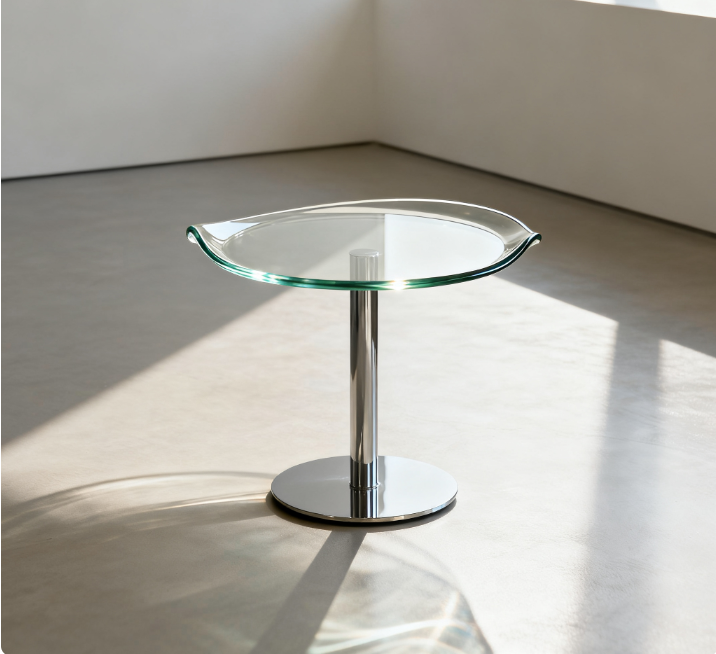
Curved coffee tables
Curved counters and showcases
Decorative interior panels
Wall cladding and feature elements
Oven doors (annealed version)
Curved refrigerator panels
Household glass components
Partition panels
Display cabinets
Non-structural curved elements
Architectural Art: Curved glass can be integrated into architectural art pieces to provide a dynamic and futuristic look.
Point of Sale Displays: Retail stores often use curved glass in point-of-sale displays to draw attention and create an elegant, high-end look.
Storefronts and Showcases: Curved glass is frequently used in storefront windows or product showcases, enhancing product visibility and the overall design of the store.
Manufacturing Process
Raw Glass Preparation
Cutting, edging, and chamfering the selected glass to avoid edge stress.
Mold Fabrication
Customized steel or ceramic molds built according to single curve, double curve, or complex shapes.
Heating & Softening
Glass is heated gradually to 600–650°C until soft enough for forming.
Bending & Forming
The glass conforms to the mold by gravity or controlled mechanical force.
Cooling & Annealing
Slow cooling eliminates internal stress; tempered versions undergo rapid cooling for strengthening.
Post-processing
Cleaning, inspection, and optional second-stage processes (laminating, coating, printing, etc.).
A: You need to clarify four key details: ① Bending radius (critical for shaping complexity, especially for small-radius designs); ② Exact dimensions (must match your design drawings, with standard size range 150×150mm–12000×3600mm); ③ Thickness (4mm–12mm is common, selected based on scenarios like building facades or furniture); ④ Glass type (e.g., tempered, laminated, Low-E glass) as per usage needs.
A: The standard delivery time is 7 days. Expedited service is available for urgent projects, but the specific timeline depends on your order quantity, customization complexity (e.g., double-curvature designs), and production schedule.
A: Common options include: ① Edge treatments (flat, rounded, beveled); ② Decorative finishes (sandblasting for matte effects, brushed textures); ③ Functional coatings (UV protection, anti-reflective, self-cleaning); ④ Drilling (for mounting/installation). Custom treatments can be requested based on your design needs.