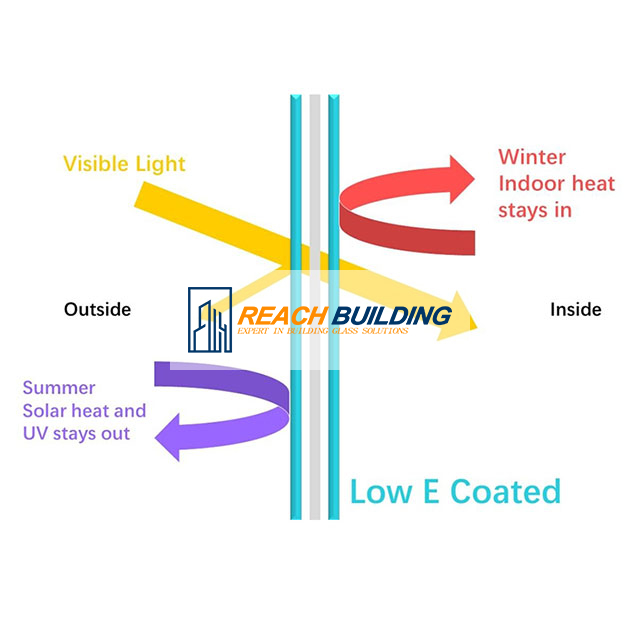
For commercial architects, builders, and procurement teams, the building envelope represents the primary battleground for energy conservation. Upgrading standard glazing to high-performance solutions is no longer an optional luxury under modern building codes. Today, balancing visible light transmittance with stringent HVAC load reduction requirements creates a complex specification challenge. Design teams often struggle to maximize natural daylight while keeping interior climates perfectly regulated. If you fail to navigate this delicate balance, you risk massive energy leaks and deeply uncomfortable interior environments. This comprehensive guide breaks down exactly how to evaluate, specify, and source low-e glass panels to meet strict energy compliance frameworks, like ASHRAE and LEED. You will learn the hidden mechanics behind the microscopic coatings. We also explore how to navigate inevitable performance trade-offs. Finally, we provide strategies to secure the right components without overpaying or compromising your core building aesthetics.
Key Takeaways
Metric Interdependence: Specifying energy efficient glass requires balancing U-Value (insulation), Solar Heat Gain Coefficient (SHGC), and Visible Light Transmittance (VLT)—optimizing one often impacts the others.
Climate dictates the coating: Soft-coat (sputtered) low-e dominates mixed and hot climates for solar control, while hard-coat (pyrolytic) excels in heating-dominated regions.
Implementation Realities: Low-E coatings introduce specific handling requirements during the manufacturing of Insulated Glass Units (IGUs), such as edge deletion and thermal stress management.
Vendor Evaluation: Choosing an OEM low-e panel partner hinges on custom scalability, warranty terms for coating degradation, and local compliance certifications.
The Role of Low-E Coated Glass in Building Envelopes
Let us explore low-emissivity technology through the precise lens of thermodynamics. Manufacturers apply microscopically thin metallic layers directly to the glass surface. These specialized metallic layers actively reflect long-wave infrared heat. At the exact same time, they allow short-wave visible light to pass through completely unimpeded. You can think of it as a highly selective filter. It intelligently sorts solar energy by wavelength.
This physical mechanism translates directly into massive operational expenditure reductions for facility managers. You significantly lower cooling loads during scorching summer months. You also minimize heating fuel consumption during freezing winters. Modern baseline energy codes, including ASHRAE 90.1, now strictly require high-performance solutions for commercial building glass facades. You simply cannot achieve standard LEED certifications using outdated, uncoated glazing.
Specifying low-e coated glass essentially creates a transparent thermal shield. It drastically alters how a building interacts with its surrounding climate. By reflecting interior heat back inside during winter, the heating system works less. By bouncing exterior solar heat away during summer, chillers consume far less electricity. This dual-action performance makes advanced glazing the cornerstone of modern sustainable architecture.
Core Evaluation Metrics: Decoding Performance Data
Evaluating energy performance requires you to master three primary metrics. These specific numbers define how your envelope behaves under real-world thermal stress.
First, consider the U-Value, known formally as thermal transmittance. This crucial metric measures total heat loss through the panel. Lower numbers are always better. Commercial building envelopes typically target U-Values between 0.25 and 0.30 for maximum baseline efficiency.
Next, look closely at the Solar Heat Gain Coefficient (SHGC). This specific value defines the exact fraction of solar radiation admitted into the interior space. An inverse relationship exists between SHGC and daily cooling costs. Lowering your SHGC directly cuts down the electrical energy your air conditioning systems consume.
Finally, we must account for Visible Light Transmittance (VLT). VLT represents the total percentage of natural daylight admitted through the glass assembly. Higher VLT percentages create brighter, more welcoming office interiors.
Designers must constantly navigate a strict trade-off matrix. Aggressively lowering your SHGC to reduce summer cooling loads often sacrifices your VLT. This sudden drop in natural light forces facility managers to increase artificial interior lighting. Ironically, excessive artificial lighting generates interior heat, which subsequently increases cooling demands. To resolve this, engineers often look at the Light-to-Solar Gain (LSG) ratio. You calculate LSG by dividing VLT by SHGC. A higher LSG indicates a highly selective glass type. It admits abundant daylight while blocking unwanted solar heat.
Metric
Definition
Goal for Hot Climates
Goal for Cold Climates
U-Value
Measure of total heat loss
Low (Prevents heat entry)
Very Low (Retains interior heat)
SHGC
Solar radiation fraction admitted
Low (Reduces cooling load)
High (Allows passive solar heat)
VLT
Natural daylight percentage admitted
Moderate to High
Moderate to High
LSG Ratio
VLT divided by SHGC
High (Maximizes light, minimizes heat)
Moderate (Balances light and warmth)
Hard-Coat vs. Soft-Coat: Selecting by Climate Strategy
Selecting the correct coating application method is highly critical. You must directly match the coating chemistry to your specific geographic location and dominant energy load. Not all microscopic coatings behave the same way under extreme weather conditions.
Hard-Coat (Pyrolytic) / Passive Low-E Manufacturers fuse this specific coating to the glass during early production. The complex pyrolytic process happens while the glass ribbon remains extremely hot.
Best for: Cold, aggressively heating-dominated climates.
Characteristics: It offers a substantially higher SHGC to allow beneficial passive solar heating. The coating is exceptionally durable. It strongly resists scratching during handling or transport. Factory workers can cut and temper it easily.
Soft-Coat (Sputtered) / Solar Control Low-E Facilities apply this advanced coating inside a vacuum chamber long after the glass cools. It uses a highly sophisticated Magnetron Sputtering Vacuum Deposition (MSVD) process.
Best for: Warm to mixed climates where extensive air conditioning forms the primary expense.
Characteristics: It delivers exceptionally low U-Values and impressive SHGC reduction. However, the raw coating remains fragile until factory workers seal it securely within an insulated glass unit (IGU). Most high-performance architectural varieties feature double or triple silver layers.
Always view these two distinct options through a strict evaluation lens. Guide your procurement strategy by assessing your building's geographic orientation. Southern and western facade exposures typically demand triple-silver soft coats to combat intense afternoon sun. Conversely, shaded northern exposures could significantly benefit from the passive heating traits of a standard hard coat.
Implementation Risks and Engineering Considerations
Integrating advanced energy efficient glass introduces several logistical and financial realities. You must acknowledge a realistic 10% to 15% upfront material cost premium over standard clear glass. However, you must immediately contextualize this initial expense against lifetime operational savings. Typical commercial projects reliably report a rapid two to five-year OpEx payback period based on energy models.
You must also address the objective reality of architectural aesthetics. High-performance solar control coatings often introduce slight green or blueish tints to the exterior reflection. Building owners must always approve these visual shifts via physical, full-scale mock-ups before mass specification. Do not rely solely on digital renders or small lab samples. Sunlight interacts uniquely with multiple silver layers in the real world.
Thermal stress presents another serious engineering risk. Absorbing and reflecting intense solar energy drastically increases the surface temperature of the pane. A stark temperature gradient forms between the hot center and the cooler shaded edges. This localized heating often requires you to heat-strengthen or fully temper the panes to prevent catastrophic thermal fracture.
Finally, you must understand a critical manufacturing nuance known as edge deletion. Soft-coat panels require fabricators to mechanically grind away the metallic coating around the extreme perimeter edges. This crucial step ensures proper primary sealant adhesion within the IGU. If a factory skips edge deletion, the perimeter seals will eventually fail. Moisture will then penetrate the airspace and permanently oxidize the microscopic silver layers.
Sourcing an OEM Low-E Panel Partner
Finding a reliable OEM low-e panel partner requires strict operational due diligence. First, carefully assess the vendor's total capacity for custom architectural demands. Can they reliably produce oversized jumbo panels for expansive lobbies? Do they have the necessary tooling for curved structural glass? Ensure they can seamlessly execute complex custom IGU makeups using specialized argon or krypton gas fills.
Quality assurance programs and strong warranties ultimately define a trustworthy supplier. Look for comprehensive commercial warranties lasting between 10 and 20 years. Read the fine print thoroughly. Pay close attention to the specific clauses regarding perimeter seal failure, microscopic coating oxidation, and internal moisture intrusion. A warranty is only useful if it directly covers the actual failure points of a soft-coat unit.
Follow a logical shortlisting process to secure the absolute best partner:
Request verified spectrophotometric data to ensure all marketing claims are officially NFRC certified.
Demand project-specific thermal modeling upfront using industry-standard tools like LBNL WINDOW software.
Audit the manufacturer's typical lead times and map out their supply chain redundancies to prevent costly project delays.
Review their specific handling protocols for fragile triple-silver soft coats to ensure minimal manufacturing waste.
Conclusion
Specifying advanced low-e glazing remains a complex, high-stakes balancing act. You must constantly weigh maximum thermal insulation against precise solar control and natural daylighting requirements.
Prioritize comprehensive full-building energy modeling over simply picking the individual glass pane with the lowest raw metrics.
Match your specific coating technology (hard-coat versus soft-coat) precisely to your localized climate demands and building orientation.
Always perform physical on-site mock-ups to confirm aesthetic tints and real-world visual reflectivity before final procurement.
Work exclusively with highly experienced fabricators who understand crucial processes like edge deletion and advanced thermal stress management.
We strongly encourage you to contact a specialized facade consultant early in the architectural design phase. You should also request detailed technical spec sheets from your shortlisted OEM partners. This proactive approach ensures your final selections align perfectly with your long-term operational goals and strict energy codes.
FAQ
Q: Does the low-e coating degrade over time?
A: Hard coats are virtually permanent since they are permanently fused to the glass during manufacturing. Soft coats are highly protected within the sealed airspace of an insulated glass unit (IGU). Degradation, such as oxidation or visible spotting, only occurs if the IGU's perimeter seal fails and exposes the internal layers to atmospheric moisture.
Q: Do low-e glass panels block UV rays?
A: Yes, they do so significantly. These specialized panels typically block 70% to 90% or more of harmful UV radiation. This high level of filtration dramatically reduces the interior fading of expensive furniture, artwork, and retail fixtures without forcing you to rely on heavy, light-blocking glass tints.
Q: Can low-e coatings be applied to existing windows?
A: While aftermarket plastic films certainly exist, true commercial-grade performance requires factory-applied metallic coatings (pyrolytic or MSVD). These are integrated directly into newly sealed IGUs. Furthermore, applying aftermarket window films often traps heat unevenly. This frequently voids existing manufacturer warranties due to massively increased thermal stress risks.
Miracle Senior Glass Technology Expert at Reach Building
Miracle is a seasoned architectural glass specialist with over 12 years of experience in tempered glass, laminated glass, insulated glass, and Low-E coated glass. At Reach Building, she focuses on product technical support, custom solutions, and industry trend analysis for global dealers, contractors, and builders.In her column, Miracle shares practical insights, project case studies, and expert advice to help construction professionals select the right glass for safer, more energy-efficient buildings.
With over 20 years of experience in building materials, Reach Building provides customized glass products and technical solutions for global construction and interior projects.
We use cookies to enable all functionalities for best performance during your visit and to improve our services by giving us some insight into how the website is being used. Continued use of our website without having changed your browser settings confirms your acceptance of these cookies. For details please see our privacy policy.