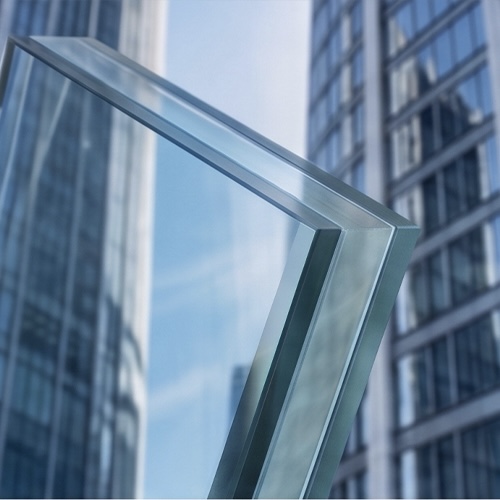
REACH BUILDING Tempered Glass is a type of safety glass produced through a high-temperature heating and rapid cooling process, which significantly improves strength, impact resistance, and thermal stability compared with standard glass. By heating the glass to over 600°C and quickly cooling it with compressed air, tempered glass develops enhanced surface compression and durability. It maintains excellent transparency and aesthetic appeal while providing reliable safety performance, making it widely used in architectural glazing, furniture, automotive, and other applications.
Low-iron glass, also known as ultra-clear glass or extra-clear glass, is manufactured with a lower iron content than standard clear float glass. This reduces the green tint commonly visible along the glass edges and provides higher transparency, improved light transmission, and more accurate color rendering.
Reach Building supplies custom low-iron glass for façades, curtain walls, railings, skylights, canopies, display cases, partitions, doors, and other architectural applications where visual clarity is important. Available processing options include tempering, lamination, insulation, coating, drilling, edge polishing, and custom shaping. Glass thicknesses, sizes, configurations, and finishes can be produced according to project drawings and performance requirements.
Curved glass refers to glass that has been shaped or bent into a curve rather than remaining flat, offering a more visually dynamic and ergonomic alternative to traditional flat glass. It's commonly used in a variety of industries, including architecture, and electronics, due to its aesthetic appeal and functional benefits.
PVB laminated glass consists of two or more glass panes bonded with one or more polyvinyl butyral (PVB) interlayers. During production, the assembled layers are processed under controlled heat and pressure to form a permanently bonded safety-glass panel.
If the glass breaks, the flexible PVB interlayer helps retain the fragments and limits the formation of falling or scattered shards. Depending on the glass thickness, pane combination, and PVB configuration, laminated glass can also improve acoustic performance and reduce UV transmission.
Custom PVB laminated safety glass is used for windows, façades, curtain walls, doors, partitions, railings, skylights, and other architectural applications. Clear, coloured, translucent, and acoustic PVB interlayers can be selected according to the project requirements.
PVB laminated glass alone should not be treated as a complete thermal-insulation solution. Where lower heat transfer is required, it can be combined with Low-E coatings and an insulated glass unit.
SGP laminated glass, commonly known as SentryGlas® laminated glass, is a high-performance safety glazing product made by bonding two or more glass panes with a stiff ionoplast interlayer. Unlike PVB, SGP is not a polyvinyl butyral material. It provides greater structural stiffness, tear resistance, edge stability, and post-breakage performance than conventional PVB interlayers.
If breakage occurs, the SGP interlayer helps retain the glass fragments and supports the damaged glass assembly more effectively. This makes SGP laminated glass suitable for structural railings, façades, curtain walls, canopies, skylights, floors, staircases, and large-format architectural glazing.
The glass thickness, interlayer thickness, heat treatment, support system, and overall configuration should be selected according to the project’s structural calculations, safety requirements, and applicable building standards.
Insulated Glass Units (IGUs) consist of two or more glass panes separated by a spacer and sealed around the edges to form an insulating cavity. The cavity can be filled with air or an inert gas, depending on the required glass configuration and thermal performance.
Compared with single-pane glass, insulated glass can reduce heat transfer and improve acoustic performance, helping create more energy-efficient and comfortable indoor environments. IGUs can also be combined with Low-E, tempered, laminated, tinted, or coated glass to meet different project requirements.
Custom insulated glass units are widely used in residential and commercial windows, doors, curtain walls, skylights, and building façades.
Low-E Insulated Glass combines a low-emissivity coating with the sealed structure of an Insulated Glass Unit (IGU). The Low-E coating helps reduce radiant heat transfer, while the sealed air or gas-filled cavity provides additional thermal insulation.
This configuration can help limit indoor heat loss during colder seasons and reduce unwanted solar heat gain in warmer conditions. Depending on the selected coating and glass configuration, it may also reduce UV transmission and help protect interior furnishings from fading.
Custom Low-E insulated glass units are suitable for energy-efficient windows, doors, curtain walls, skylights, and building façades in residential, commercial, and industrial projects.
Coated tinted glass is a high-performance architectural glass that combines the solar control and aesthetic qualities of tinted glass with the functional enhancements of surface coatings. This product is engineered to meet modern building requirements for energy efficiency, thermal comfort, and visual appeal.Coated tinted glass is the perfect solution for architects and designers seeking a balance of beauty, performance, and sustainability. Its ability to provide solar control, thermal insulation, and modern aesthetics makes it an essential component in energy-efficient building design.
Low-E (Low Emissivity) coated glass is a type of glass that has been treated with a thin, metallic coating designed to reduce heat transfer. The coating is so thin that it is invisible to the naked eye and allows the glass to perform better in energy efficiency, providing improved insulation and minimizing the amount of heat that escapes or enters a building.
Float tempered glass, also known as toughened glass, is a high-strength safety glass manufactured through a process of extreme heating followed by rapid cooling. This process improves the glass’s durability, impact resistance, and thermal stability, making it an ideal choice for applications requiring strength and safety. Float glass is commonly used as the base material, which is then tempered to create a product that is about five times stronger than standard annealed glass.
Engineered for both visual distinction and thermal performance, Reach Building’s premium tinted glass provides a reliable solar control tinted glass solution for modern architecture. Produced by adding metallic oxides during the float glass manufacturing process, our tinted glass absorbs and re-radiates solar energy, effectively reducing glare and heat transmission. Whether you are sourcing tinted glass sheets wholesale for large-scale facades or require custom-cut panels for interior design, our facility ensures strict color consistency, flawless edges, and jumbo size tinted glass capabilities up to 12,000mm to meet the most demanding global projects.
Reach Building Forest Glass is a type of frosted tempered glass designed to combine privacy, daylight diffusion, and safety. One surface is treated through a controlled sandblasting process to create a translucent matte finish that softens visibility while allowing natural light to pass through.
After the required cutting, edge processing, drilling, and surface treatment are completed, the glass can be tempered to increase its strength and provide a safer breakage pattern. Custom Forest Glass is suitable for office partitions, interior doors, bathrooms, shower en Bikes://grade? Stop. Need typo. Ensure good.
lobster? Let's craft.
Botticelli.
glass panels, cabinets, retail displays, and other residential or commercial interior applications.
Colored patterned glass is produced by pressing molten glass between two rollers, one of which has a textured design. The addition of pigments or dyes during the manufacturing process gives the glass its color. The result is a visually appealing, textured surface that diffuses light, provides privacy, and enhances design aesthetics.