Noise pollution is a growing concern in modern buildings, especially in areas exposed to traffic, railways, and aircraft noise. While standard PVB laminated glass provides safety benefits and some sound insulation, specialized acoustic PVB interlayers are designed to improve vibration damping and reduce sound transmission across certain frequency ranges.
This guide explains how acoustic PVB improves sound insulation, how STC and Rw ratings work, and how acoustic laminated glass can be used in commercial projects and combined with insulated glass units (IGUs), helping architects, glazing contractors, and project buyers make informed decisions.
What Is Acoustic PVB and How Does It Differ from Standard PVB?
Acoustic PVB laminated glass consists of two or more glass panes bonded together with a specialized polyvinyl butyral (PVB) interlayer designed to improve sound insulation. Its effectiveness comes largely from the interlayer's viscoelastic properties, which help dissipate vibration energy as sound waves interact with the glass assembly.
How Acoustic PVB Interlayers Reduce Sound Transmission
When sound waves reach a glass pane, they cause it to vibrate. These vibrations can transmit sound energy into the indoor environment. The amount of sound transmitted depends on factors such as glass thickness, pane configuration, sound frequency, and the performance of the surrounding window or facade system.
In laminated glass, the PVB interlayer bonds the glass panes together and contributes to the overall acoustic performance. Its viscoelastic behavior helps absorb and dissipate some of the energy associated with glass vibration, reducing sound transmission under suitable conditions.
Acoustic Laminated Glass Sound-Insulation Diagram: Illustrates how the PVB interlayer helps reduce sound transmission.
Acoustic PVB vs. Standard PVB in Laminated Glass
Acoustic PVB and standard PVB are both used as interlayers in laminated glass, but they differ in their intended performance characteristics.
Standard PVB primarily provides glass bonding, impact resistance, and post-breakage safety.
Acoustic PVB is specifically engineered to provide enhanced vibration damping and improve sound insulation across certain frequency ranges.
The key difference lies in the interlayer's viscoelastic properties. Acoustic PVB is designed to dissipate more vibration energy within certain frequency ranges, potentially reducing sound transmission compared with conventional PVB configurations.
To learn more about how PVB interlayers bond glass panes and enhance safety, read our guide to PVB Laminated Glass.
Understanding STC and Rw Ratings for Acoustic Glass
When evaluating acoustic laminated glass, STC and Rw are two important ratings used to describe sound insulation performance. Although both summarize how effectively a tested assembly reduces airborne sound transmission, they are based on different rating systems and should not be treated as interchangeable.
STC Rating: Sound Transmission Class
Sound Transmission Class (STC) is a single-number rating used primarily in North America to describe the airborne sound insulation of building elements. Laboratory sound transmission loss is measured according to ASTM E90, while ASTM E413 specifies the procedure for calculating the STC rating.
A higher STC rating generally indicates better airborne sound insulation. As a practical reference:
A difference of 1 STC point is usually barely noticeable.
A difference of 3–5 STC points generally represents a noticeable improvement in sound insulation.
A difference of 10 STC points is often associated with approximately half the perceived loudness of transmitted sound.
For acoustic laminated glass, STC ratings help compare tested glazing configurations under the same rating system. However, the rating alone cannot predict performance against every noise source, particularly when low-frequency traffic, aircraft, or industrial noise is involved.
Rw Rating: Weighted Sound Reduction Index
The Weighted Sound Reduction Index (Rw) is a single-number rating defined in ISO 717-1. It summarizes airborne sound insulation based on laboratory sound transmission loss measurements, typically obtained using the applicable parts of the ISO 10140 series.
Rw is widely used in projects that follow ISO-based acoustic assessment procedures. Like STC, a higher Rw value generally indicates better airborne sound insulation under the relevant rating method. For international projects, Rw helps buyers compare glazing systems tested under ISO standards, while the Ctr value provides additional insight into sound insulation against road traffic noise.
Typical Performance Ranges for Acoustic PVB Laminated Glass
The following table shows typical laboratory performance ranges for common acoustic PVB laminated glass configurations (center-of-glass values). Actual results vary depending on exact interlayer grade, glass type, and test laboratory.
Configuration
Total Nominal Thickness
Typical STC
Typical Rw (C; Ctr)
Notes
6 mm + Acoustic PVB + 6 mm
12.76 – 13.5 mm
38 – 40
38–40 (–1; –5 to –6)
Good baseline for general urban noise
8 mm + Acoustic PVB + 8 mm
16.76 – 17.5 mm
40 – 42
40–42 (–1; –5 to –7)
Better low-frequency control
10 mm + Acoustic PVB + 10 mm
20.76 – 21.5 mm
42 – 44
42–44 (–2; –6 to –8)
Suitable for heavier traffic
Asymmetric (6 + Acoustic PVB + 10)
16.76 – 17.5 mm
41 – 43
41–43 (–1; –5 to –7)
Often better coincidence control
High-performance multi-layer Acoustic PVB
16–25 mm
44 – 48+
44–48 (–2; –6 to –9)
Premium solutions for demanding sites
Note: These are typical laboratory values for reference only. For project-specific performance data, please contact REACH BUILDING for detailed test reports.
Why Choose Acoustic Laminated Glass for Commercial Projects?
Acoustic laminated glass offers commercial buildings a practical way to address external noise while maintaining the safety and design flexibility of laminated glazing. By combining glass panes with an interlayer designed to improve vibration damping, it can help reduce sound transmission when the glass configuration is properly selected and tested.
Improved Indoor Acoustic Comfort
In offices, hotels, retail spaces, and other commercial buildings, external noise from traffic and surrounding activities can affect occupant comfort and the indoor environment. Acoustic laminated glass can help reduce airborne sound transmission, supporting quieter interior spaces when specified as part of a suitable glazing system.
Safety and Post-Breakage Performance
Like other laminated glass products, acoustic laminated glass uses an interlayer to bond the glass panes together. If the glass breaks, the interlayer helps retain glass fragments, reducing the risk of falling shards. The actual safety performance depends on the glass construction and applicable product standards.
Design Flexibility for Commercial Buildings
Acoustic laminated glass can be specified in different glass thicknesses, dimensions, and configurations to meet project requirements. It can also be incorporated into suitable window and facade systems, allowing architects and contractors to consider acoustic performance alongside appearance, daylight, and other building requirements.
Combining Acoustic Laminated Glass with Insulated Glass Units (IGUs)
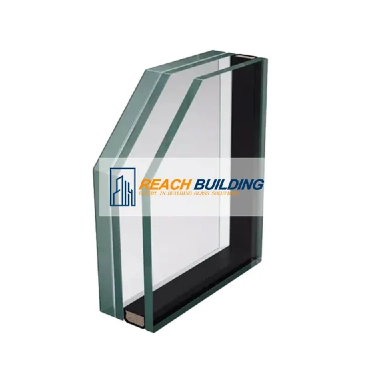
For buildings requiring enhanced sound insulation and thermal efficiency, acoustic laminated glass can be incorporated into an insulated glass unit (IGU). This configuration combines the vibration-damping properties of the laminated glass interlayer with the acoustic and thermal characteristics of the sealed cavity between the glass panes.
The cavity creates a mass-air-mass system in which the glass panes act as two masses and the enclosed air provides an elastic connection. At the system's resonance frequency, sound transmission may increase, reducing insulation in a particular frequency range. Glass thickness, pane asymmetry, cavity width, and interlayer properties all influence the overall acoustic performance.
Combining acoustic laminated glass with an insulated glass unit helps improve sound insulation while maintaining thermal performance.
For projects requiring acoustic laminated IGUs, contact REACH BUILDING to discuss your glass specifications, acoustic performance targets, and thermal requirements. Our team can help you evaluate suitable glass configurations and provide relevant product information to support your project needs.
Conclusion
Acoustic laminated glass helps reduce sound transmission through specialized interlayers that dampen glass vibrations. Choosing the right interlayer and glass configuration is essential for achieving the desired sound insulation performance.
REACH BUILDING can provide PVB laminated glass with acoustic PVB interlayer options for projects requiring enhanced sound insulation. Contact REACH BUILDING to discuss your project requirements and find a suitable glass solution.
Frequently Asked Questions
Can Standard Laminated Glass Provide Good Sound Insulation?
The required STC rating depends on surrounding noise levels and project requirements. STC 38–42 may be a useful reference for some office projects, but the appropriate target should be determined by acoustic assessments and applicable standards.
Does Thicker Glass Always Make a Room Quieter?
No. Thicker glass does not always provide better sound insulation at every frequency. Glass thickness, pane combinations, interlayer properties, and the complete glazing system all affect acoustic performance.
How Can I Verify the Sound Insulation Performance of Acoustic Glass?
Check the STC or Rw ratings and request relevant laboratory test reports for the proposed glass configuration. Make sure the test results match your project requirements and clarify whether they apply to the glass alone or the complete window system.
Miracle Co-founder of Reachbuilding
Miracle owns a glass factory that has been in operation for 40 years. His family has been engaged in the construction industry for over 60 years and possesses extensive engineering and production experience. At Reach Building, he focuses on product technical support, custom solutions, and industry trend analysis for global dealers, contractors, and builders.In his column, Miracle shares practical insights, project case studies, and expert advice to help construction professionals select the right glass for safer, more energy-efficient buildings.
With nearly 30 years of experience in building materials, REACH BUILDING provides customized glass products and technical solutions for global construction and interior projects.