Choosing glass for office partitions involves balancing several practical requirements. A conference room may need greater acoustic privacy, while an open-plan workspace may prioritize natural light and visibility. Glass type, safety performance, thickness, and installation methods can all affect how well a partition meets these needs.
So, which glass is best suited to your office project? This guide compares common glass types for office partitions, explains their suitability for different spaces, and outlines the key considerations for selecting and ordering the right glass.
What Types of Glass Are Used for Office Partitions?
Glass used for office partitions comes in different types, each with its own characteristics. Tempered glass is heat-treated for added strength, while laminated glass is made by bonding two or more glass panes with an interlayer. Frosted glass provides a translucent finish for visual privacy, whereas low-iron glass offers greater clarity with less of the green tint found in standard clear glass.
These options are not mutually exclusive. For example, low-iron glass can be tempered, and frosted glass can be laminated. Combining different glass types and finishes allows buyers to specify configurations that meet their project's safety, appearance, and performance requirements.
Safety & Glass Construction: Tempered and Laminated Glass
Monolithic tempered glass is commonly specified for frameless office partitions and glass doors. Its heat-treated structure provides greater mechanical strength than ordinary annealed glass of the same thickness. When broken, it typically fragments into small, relatively blunt pieces, reducing the risk of serious cutting injuries. This is an important consideration when selecting glass for doors and panels along busy circulation routes.
Laminated glass offers a different approach to breakage safety. It consists of multiple glass panes bonded with an interlayer, usually PVB. If one or both panes break, the interlayer helps retain the fragments rather than allowing them to scatter freely. Depending on the framing and support system, the damaged glass may remain within the opening. This makes laminated construction relevant for projects where post-breakage retention is an important requirement.
Where both increased strength and post-breakage glass retention are required, tempered-laminated glass combines the strength of heat-treated glass with an interlayer that helps hold glass fragments together if the panel breaks.
Appearance & Light Transmission: Low-Iron, and Frosted Glass
Glass selection also affects how an office partition looks and how people interact with the surrounding space. Low-iron glass is often chosen for its high clarity and neutral appearance, while frosted glass provides visual screening without completely blocking natural light. Each serves a different design purpose, depending on the desired balance between transparency and privacy.
Low-Iron Glass (also known as ultra-clear glass or extra-clear glass) contains less iron than standard clear glass, reducing the greenish tint commonly visible along glass edges. It offers higher visible light transmission and more accurate color representation, making it particularly suitable for large glass partitions, reception areas, and executive offices where a clean, unobstructed appearance is important. The difference is especially noticeable in thicker panels and interiors with white or light-colored finishes. Low-iron glass can also be tempered or laminated to meet the project's safety requirements.
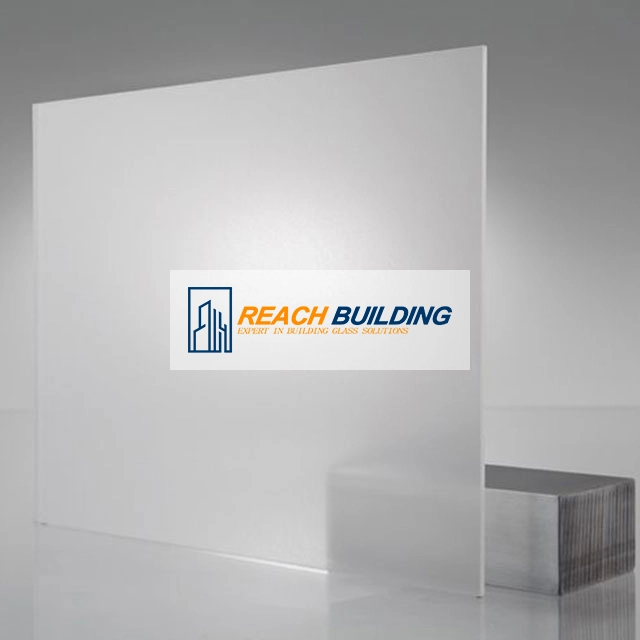
Frosted Glass is commonly used in office partitions where visual privacy is needed without completely blocking natural light. Its translucent surface diffuses incoming light and obscures direct views, making it suitable for meeting rooms, private offices, and enclosed workspaces. Frosted finishes can be created through acid etching or sandblasting, with different levels of coverage depending on the design. Full-panel frosting provides more extensive visual screening, while partial frosting, such as horizontal bands or custom patterns, allows some areas to remain transparent.
Acoustic Laminated Glass and PDLC Smart Glass for Office Partitions
Some office environments require more than basic safety and visual design. Meeting rooms may need better speech privacy, while executive offices and multi-purpose spaces may require privacy that can be adjusted as needed. Acoustic laminated glass and PDLC smart glass address these different requirements through specialized glass constructions and technologies.
Acoustic Laminated Glass incorporates a specialized acoustic PVB interlayer between two or more glass panes. Compared with standard PVB interlayers, acoustic interlayers are designed to improve sound insulation in suitable glass configurations by reducing sound transmission across certain frequency ranges.
SpectraVeil PDLC Smart Glass, REACH BUILDING's branded switchable privacy solution, offers more than conventional clear-to-frosted glass switching. It switches quickly between transparent and softly frosted states: transparent when powered on and opaque when powered off. With switching times of less than 45 milliseconds from OFF to ON and less than 100 milliseconds from ON to OFF, it allows office spaces to adapt quickly to changing privacy needs.
SpectraVeil PDLC Smart Glass in a modern meeting room, providing on-demand visual privacy while maintaining a bright, open office environment.
How to Balance Privacy and Natural Light in Office Partitions
Office partitions need to provide sufficient visual privacy without making the workspace feel enclosed or reducing access to natural light. The right glass selection depends on how much visibility needs to be restricted, where privacy is required, and whether the level of privacy needs to change throughout the day. From fixed frosting treatments to switchable smart glass, several options can help balance these requirements.
What Affects Visual Privacy and Natural Light?
Several factors influence how much privacy and daylight a glass partition provides.
Glass Transparency: Clear glass maintains unobstructed sightlines and allows natural light to pass through, while translucent glass diffuses light and limits direct visibility.
Frosting Coverage: Full frosting provides more consistent visual screening, while partial frosting preserves clear sections for greater visibility and light transmission.
Lighting Conditions: Bright differences between adjacent spaces can affect how clearly people, shadows, and movement are visible through translucent glass.
Partition Layout: The position and height of glass panels, along with nearby workstations and circulation areas, influence sightlines and the level of privacy required.
These factors should be considered together when selecting glass for different office areas. The goal is to achieve the required level of visual privacy while maintaining a bright and open working environment.
Full vs. Partial Frosting: Choosing the Right Level of Privacy
Frosted glass is a practical option for office partitions that require visual screening while still allowing natural light to enter the space. The extent of the frosting treatment determines how much visibility is restricted.
Full Frosting applies a translucent finish across the entire glass panel. It is suitable for meeting rooms, private offices, and other areas where consistent visual privacy is preferred. Although direct views are obscured, natural light can still pass through the glass, helping maintain a bright interior.
Partial Frosting applies the frosted finish only to selected areas of the glass, such as a horizontal band across the main viewing area. The remaining sections stay clear, preserving sightlines and allowing more direct visibility between spaces. This approach is often suitable for meeting rooms and office partitions where some privacy is needed without fully separating the space visually.
The choice between full and partial frosting depends on the intended use of the room, the required privacy level, and the desired appearance of the partition. Frosting patterns and coverage can also be customized to suit the office layout and interior design.
PDLC Smart Glass for Flexible Office Privacy
Unlike fixed frosted glass, PDLC Smart Glass allows office partitions to switch between transparent and translucent states, giving users greater control over visual privacy. It is particularly suitable for meeting rooms, boardrooms, and executive offices where visibility requirements change throughout the day.
Beyond on-demand privacy, REACH BUILDING's SpectraVeil PDLC Smart Glass offers additional design possibilities for commercial interiors. In its frosted state, the glass can serve as a projection and display surface for presentations, collaborative meetings, and brand visuals. Its patterned privacy design also supports customized sizes, shapes, decorative patterns, and partial frosting, allowing privacy areas to be integrated into the overall partition design.
SpectraVeil PDLC Smart Glass doubles as a projection surface in its opaque state, supporting presentations, video displays, and visual content sharing in modern office spaces.
Safety Considerations for Office Glass Partitions
Safety is an important consideration when selecting glass for office partitions, particularly in areas where people frequently pass by or come into direct contact with glass panels. Glass selection should account for the installation location, panel dimensions, support conditions, and applicable building safety requirements.
Glass Doors and High-Traffic Areas
Glass doors and transparent partitions along busy walkways are exposed to frequent human contact. Clear glass can be difficult to distinguish from an open passage, increasing the risk of accidental collisions. Contrasting manifestation bands or visual markings on the glass can help make these surfaces more visible.
For the glazing itself, tempered safety glass is commonly used in office doors and partitions. Where retaining glass fragments after breakage is also a priority, laminated or tempered-laminated glass can provide an additional level of protection. Door hardware, including hinges, patch fittings, and handles, must also be compatible with the selected glass thickness, panel weight, and configuration.REACH BUILDINGcan also assist with matching glass specifications to suitable hardware, helping ensure compatibility between the glass panels and door fittings.
Floor-to-Ceiling Glass Partitions
Full-height glass partitions create uninterrupted sightlines, but their large panel dimensions introduce different structural requirements from smaller interior glazing. Glass thickness, panel width and height, fixing points, and support conditions all influence how the partition performs under lateral loads and everyday use.
For frameless systems, the fixing method is particularly important because glass panels may rely on floor channels, top supports, or localized hardware connections rather than continuous framing. The glass configuration and supporting system must work together to provide the required stability.
Choosing the Right Glass for Your Office Partitions
Office partitions can use different glass types and configurations to achieve the desired balance of transparency, privacy, and safety. From clear and frosted glass to PDLC smart glass, the choice also depends on panel dimensions, installation methods, and project-specific safety requirements.
At REACH BUILDING, we provide customized glass solutions for office partitions, including glass selection, processing, and compatible hardware options. Whether your project requires clear partitions, frosted glass, or PDLC smart glass, our team can help develop a configuration suited to your design and project requirements.
Miracle Co-founder of Reachbuilding
Miracle owns a glass factory that has been in operation for 40 years. His family has been engaged in the construction industry for over 60 years and possesses extensive engineering and production experience. At Reach Building, he focuses on product technical support, custom solutions, and industry trend analysis for global dealers, contractors, and builders.In his column, Miracle shares practical insights, project case studies, and expert advice to help construction professionals select the right glass for safer, more energy-efficient buildings.
With nearly 30 years of experience in building materials, REACH BUILDING provides customized glass products and technical solutions for global construction and interior projects.