A glass sheet may look flawless, but it can still “get sick” during manufacturing. Bubbles, inclusions, surface marks, and optical distortion can all develop when something goes wrong in melting, forming, annealing, or handling.
Because float glass and rolled glass are formed differently, their imperfections also tell different stories. This guide explains the most common defects, what causes them, and how manufacturers can prevent them.
Table of Contents
Toggle
1. Float Glass vs. Rolled Glass: Two Different Ways to Form a Glass Sheet
1.1 Float Glass: Formed on a Bath of Molten Tin
The float process begins with a carefully proportioned batch of raw materials such as silica sand, soda ash, limestone, and other ingredients. The batch is melted at high temperature until it becomes a homogeneous glass melt. After melting and refining, the molten glass flows onto a bath of molten tin. Because glass is lighter than tin, it spreads across the tin surface instead of sinking into it. Gravity and surface tension help the ribbon level itself, producing very flat, nearly parallel surfaces. The glass ribbon is then gradually cooled, leaves the tin bath, passes through an annealing lehr to reduce residual stress, and is finally inspected and cut.
The great strength of the float process is its ability to produce glass with excellent flatness, optical quality, and thickness consistency. These properties make float glass a fundamental base material for architectural glazing and for further processes such as tempering, laminating, coating, silvering, and insulating glass fabrication.
float glass manufacturing process
1.2 Rolled Glass: Formed Between Rollers
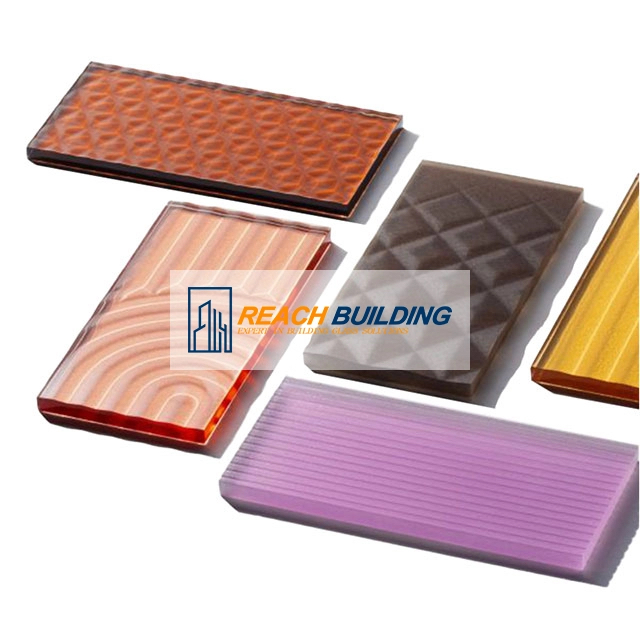
Rolled glass follows a different forming route. Instead of flowing onto a tin bath, the molten glass is fed between a pair of rotating forming rollers. The gap between the rollers determines the approximate thickness of the glass ribbon, while the roller surfaces help define its surface appearance. When one or both rollers carry an engraved pattern, that pattern is transferred into the hot glass. The result is commonly referred to as patterned glass, which can diffuse light, provide privacy, or create decorative surface effects.
Because rolled glass is shaped through direct contact with forming rollers, roller condition, roller alignment, cooling, glass temperature, and feeding stability become critical quality variables. This is why float glass and rolled glass may begin with similar melting processes but develop very different imperfections during forming.
rolled glass manufacturing process
2. Where Do Glass Manufacturing Imperfections Come From?
Glass defects rarely appear without a cause. Most can be traced back to one of three stages: melting and refining, forming, or annealing and handling.
2.1 Melting and Refining
Some imperfections develop before float and rolled glass production even begin to differ.
If raw materials do not melt completely, or if refractory material from the furnace enters the glass melt, solid particles may remain as stones or inclusions.
If gases generated during melting are not removed effectively during refining, bubbles may remain in the glass.
Because both float and rolled glass pass through melting and refining stages, these defects can occur in either type of glass.
2.2 Forming
This is where the two manufacturing routes begin to create their own characteristic defect patterns.
In float production, the glass is in direct contact with the tin bath. Bath atmosphere, tin condition, temperature distribution, ribbon movement, and edge-control equipment can therefore influence surface quality, thickness, and optical performance.
In rolled glass production, the glass contacts forming rollers instead. Roller wear, contamination, temperature imbalance, incorrect roller gap, or unstable glass feeding can appear directly in the finished pattern or surface.
The manufacturing route therefore leaves its own fingerprint on the glass.
2.3 Annealing and Cold-End Handling
After forming, both types of glass still have to cool under controlled conditions. At this stage, float and rolled glass once again share many of the same risks. If the annealing profile is poorly controlled, excessive residual stress may remain in the sheet. This can increase the risk of cutting problems, edge cracking, or breakage during subsequent processing. Dirty rollers, glass fragments, improper transport, or glass-to-glass contact can also introduce scratches and other surface damage.
3. Common Float Glass Defects: Causes and Prevention
3.1 Tin-Bath-Related Surface Imperfections
How They Develop
The tin bath is one of the defining features of float glass production, but it also creates a unique group of surface-quality risks. Tin oxidation, dross, surface contamination, unstable furnace atmosphere, or poor bath housekeeping can contribute to tin pickup and other tin-related surface imperfections. Because one side of the glass ribbon is in direct contact with molten tin, the bottom—or tin side—also develops chemical and surface characteristics that differ from the air side.
How They Are Controlled
Stable tin-bath operation is essential. Manufacturers need to control the protective atmosphere, limit unwanted oxidation, maintain bath cleanliness, monitor operating temperatures, and regularly inspect equipment exposed to the tin environment. When tin-related defects suddenly increase, the bath atmosphere, contamination sources, equipment condition, and tin quality should all be investigated rather than treating the visible mark as an isolated problem.
3.2 Bubbles and Seeds
How They Develop
Bubbles usually originate upstream during melting and refining. Raw-material reactions generate gases as the batch melts. These gases need sufficient temperature, time, and refining conditions to rise through the molten glass and escape before forming. If refining is incomplete, small bubbles—often referred to as seeds—or larger bubbles may remain trapped in the finished sheet. Their appearance, size, shape, and distribution can provide useful clues about where they originated.
How They Are Controlled
Good bubble control starts in the furnace. Batch composition, moisture content, melting temperature, refining conditions, glass residence time, and process stability all need to work together. The objective is not simply to raise the furnace temperature, but to maintain a stable thermal and chemical environment that allows gases to leave the glass before the ribbon reaches the forming stage.
3.3 Stones and Inclusions
How They Develop
Not every solid particle entering the glass melt disappears completely. Unmelted batch particles, refractory fragments, or other foreign material can survive the melting process and become embedded in the glass as stones or inclusions. These imperfections may appear as opaque or translucent points and can be surrounded by localized stress. For glass intended for further processing, inclusions deserve particular attention because defects that seem small in an annealed sheet may become more important after cutting or heat treatment.
How They Are Controlled
Prevention begins with raw-material consistency and furnace condition. Batch particle size should be well controlled, contamination should be minimized, and refractory materials should be selected and maintained according to the operating environment. Areas that are continuously exposed to molten glass—such as furnace refractories, throats, channels, and other transfer components—also require regular inspection. Sufficient melting and refining time remain essential.
3.4 Optical Distortion
How It Develops
A sheet of glass may look perfectly transparent and still distort the image seen through it. Optical distortion can result from variations in thickness, ribbon geometry, temperature distribution, or forming conditions. In float production, unstable temperature fields or inconsistent ribbon control may change how the glass stretches and levels across its width. Even relatively small variations can affect the way light passes through the finished sheet. This becomes especially noticeable when viewing straight architectural lines through large areas of glass.
How It Is Controlled
Stable forming conditions are the foundation of optical quality. Tin-bath temperature zones, ribbon speed, edge-control equipment, and transverse temperature distribution should remain consistent. Thickness and optical quality should also be monitored continuously or at defined inspection points so that localized distortion can be traced back to the corresponding process zone.
3.5 Scratches and Surface Damage
How They Develop
Unlike bubbles or stones, scratches often appear after the glass has already been formed. Glass fragments, contaminated rollers, worn handling equipment, improper stacking, or sliding contact can all leave linear marks on the surface. The damage may be cosmetic, but deeper scratches can also affect subsequent cutting, coating, laminating, or heat treatment.
How They Are Controlled
Clean handling conditions are critical. Rollers and conveyors should be inspected regularly, broken glass should be removed quickly, and direct friction between sheets should be minimized. Transport and stacking systems should also keep the glass properly separated and supported. For processors buying float glass as a base material, these seemingly simple quality issues can have a direct impact on downstream yield.
4. Common Rolled and Patterned Glass Defects: Causes and Prevention
4.1 Poor or Incomplete Pattern Definition
How It Develops
Patterned glass depends on the forming rollers to reproduce a surface design accurately. If the engraved pattern becomes worn, the glass temperature is too low, the roller gap is incorrect, or forming pressure is insufficient, the pattern may appear shallow, uneven, or incomplete. Unstable feeding can also make the pattern vary across the width of the ribbon.
How It Is Controlled
Roller condition should be inspected regularly and worn patterns repaired or replaced when necessary. Glass temperature, roller gap, forming pressure, and feed stability need to be adjusted as one system rather than independently. After a roller change or major adjustment, trial production should confirm pattern definition before full-scale production resumes.
4.2 Roller Marks
How They Develop
A damaged or contaminated forming roller can reproduce the same defect again and again. Scratches, dents, adhered glass, or localized roller deformation may create roller marks that repeat at intervals related to roller rotation. The periodic nature of the mark is often an important diagnostic clue: when the same imperfection appears at regular distances, the roller itself should be one of the first components inspected.
How They Are Controlled
Forming rollers need protection from impact, contamination, and improper cleaning. Adhered glass should be removed with appropriate tools and procedures rather than by methods that may damage the roller surface. Cooling also needs to remain uniform. Uneven roller temperature can cause thermal distortion, which may then be transferred repeatedly into the glass ribbon.
4.3 Bubbles and Entrapped Air
How They Develop
Rolled glass can inherit bubbles from the melting and refining process just like float glass. However, the rolling stage can introduce an additional mechanism: air may become trapped between the hot glass and roller surface during forming. These bubbles may differ in size, location, and distribution from furnace-origin bubbles and can sometimes appear concentrated near the formed surface.
How They Are Controlled
Upstream refining still needs to be stable, but the forming process also matters. The flow of glass into the rollers should remain even, the glass temperature should be appropriate for forming, and the roller surface should be maintained in stable condition. Roller speed, gap, and glass feed should be adjusted together to reduce opportunities for air entrapment.
4.4 Thickness Variation
How It Develops
Rolled glass thickness depends strongly on roller geometry and forming conditions. If the roller gap differs from one side to the other, the rollers deform under thermal or mechanical load, or the glass temperature varies across the ribbon, the finished sheet may become thicker in one area and thinner in another. This becomes particularly important for applications with strict dimensional or optical requirements.
How It Is Controlled
Roller alignment and gap should be checked accurately across the working width. Cooling must remain stable enough to limit thermal deformation, while glass temperature should be as uniform as practical before entering the forming zone. Regular thickness measurements allow operators to detect drift before it develops into a large quantity of nonconforming glass.
4.5 Surface Pitting
How It Develops
Small hard particles, adhered glass, or contamination on the forming roller may press localized depressions into the hot glass surface. The resulting surface pits can scatter light and reduce visual quality. Because the roller repeatedly contacts the glass ribbon, a contamination problem that is not corrected quickly can affect a large amount of production.
How It Is Controlled
Roller cleanliness is the first line of defense. Operators should monitor the roller surface regularly and remove contamination before it becomes embedded or causes repeated damage. Glass temperature and roller cooling also need to be balanced to reduce unwanted sticking. When pitting appears suddenly, checking the forming surface should usually take priority over adjusting unrelated process parameters.
4.6 Edge Cracks and Microcracks
How They Develop
The edges of a glass ribbon often cool and behave differently from the center. Excessive temperature gradients, poor annealing, mechanical damage, or unsuitable cutting conditions can introduce edge cracks or microcracks. Patterned glass can be particularly sensitive because its non-uniform surface geometry may create a more complex stress distribution near the edge.
How They Are Controlled
The annealing profile should be matched to the glass thickness, pattern, and production speed. Edge cooling should remain controlled, while cutting wheels and other tooling should be kept in good condition and used with appropriate pressure. Careful edge handling after cutting is equally important because small edge defects can propagate during later processing or installation.
5. Why Base-Glass Quality Matters Beyond the Manufacturing Line
A manufacturing imperfection does not always end its story at the annealing lehr. Many sheets will later be cut, edged, tempered, laminated, coated, silvered, drilled, or assembled into insulating glass units. Each additional process places new thermal or mechanical demands on the original glass. A small inclusion may become a higher-risk stress concentration during heat treatment. A deep scratch can reduce processing yield. Thickness variation can complicate downstream fabrication. Poor optical quality becomes more visible when large sheets are installed in façades.
This is why base-glass quality should be evaluated according to the intended processing route rather than by appearance alone.
If you want to see how float glass moves from the original sheet into different architectural and processed-glass products, our glass processing workflow explains the main fabrication routes from cutting and edging to tempering, laminating, coating, and insulating glass production. For buyers and processors, the practical question is therefore not simply: “Does this glass look clear?”
It is: “Will this glass remain consistent and reliable through the processes required for my final product?”
Conclusion
Float glass and rolled glass follow different forming routes, but effective defect prevention follows the same basic principle: control the variables before the finished glass reveals the problem. Glass may not be able to describe what happened on the production line, but its bubbles, inclusions, marks, patterns, and distortions often tell the story clearly enough. The key is knowing how to read those signals.
At REACH BUILDING, understanding how these imperfections develop informs the way we approach glass selection, production control, inspection, and further processing. By controlling the factors that commonly lead to avoidable defects, we work to maintain consistent quality across both float glass and rolled/patterned glass. Whether you need dependable base glass for further fabrication or rolled glass for a specific architectural or industrial application, our team can help you evaluate the right specifications, supply suitable glass, and provide professional guidance for your project. Contact the REACH BUILDING teamto discuss your float glass or rolled glass requirements.
Miracle Co-founder of Reachbuilding
Miracle owns a glass factory that has been in operation for 40 years. His family has been engaged in the construction industry for over 60 years and possesses extensive engineering and production experience. At Reach Building, he focuses on product technical support, custom solutions, and industry trend analysis for global dealers, contractors, and builders.In his column, Miracle shares practical insights, project case studies, and expert advice to help construction professionals select the right glass for safer, more energy-efficient buildings.
With nearly 30 years of experience in building materials, REACH BUILDING provides customized glass products and technical solutions for global construction and interior projects.
We use cookies to enable all functionalities for best performance during your visit and to improve our services by giving us some insight into how the website is being used. Continued use of our website without having changed your browser settings confirms your acceptance of these cookies. For details please see our privacy policy.